Your paper lunch box machine is up and running. The boxes look good coming off the line. But three weeks later, a customer calls: “The boxes are popping open during delivery.” Or worse: “The hinge cracked, and the food leaked.”
The problem is often invisible at the moment of production—and it usually traces back to one decision: adhesive choice.
Adhesive affects bonding strength, food-contact safety, production speed, and long-term reliability. This guide compares the two primary adhesive types—cold glue and hot melt—across the factors that directly determine paper box quality, so you can select the right system for your production needs.
How Adhesives Work: The Fundamental Difference
Cold Glue (Water-Based Adhesive)
Cold glue bonds through evaporation and absorption. The water soaks into paper fibers, then evaporates, leaving a flexible polymer film. This creates a bond that absorbs impact and flexes with the paperboard.
Key characteristics: The bond remains somewhat flexible after curing, which is important for boxes that will be opened and closed multiple times (like clamshell burger boxes). When stacked under load, cold glue bonds can flex rather than crack, reducing “pop-open” failures in delivery bags.
Hot Melt (Thermoplastic Adhesive)
Hot melt is 100% solid at room temperature. Heated to 150–180°C, it turns liquid, then hardens within seconds as it cools. The bond is rigid and instant.
Key characteristics: The bond is extremely strong but brittle. For high-speed packing lines where boxes are filled immediately, hot melt’s instant set is valuable. But for boxes subjected to stacking pressure or temperature fluctuations, the rigid bond can be more prone to failure.
How Adhesive Amount Affects Box Quality
Adhesive quantity is a critical quality variable that is often overlooked during production.
What Happens with Too Little Adhesive
-
Weak joints that open under load—the box fails at the seam
-
Hinge cracking from insufficient bond strength at the fold line
-
Rejected shipments from fast-food chains with quality inspection protocols
What Happens with Too Much Adhesive
-
Squeeze-out visible on the box surface (cosmetic defect)
-
Contamination risk for food-contact surfaces
-
Adjacent boxes sticking together in the output stack
How Each Adhesive Type Controls Amount
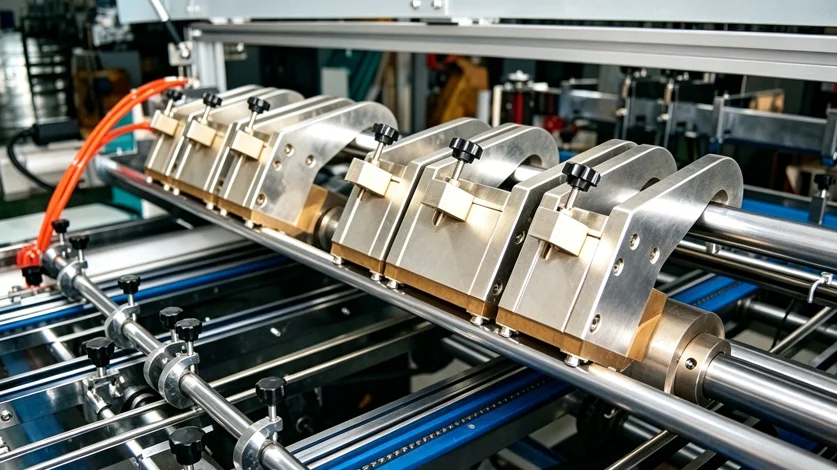
Cold glue systems: Hongshuo’s machines use precision applicators (nozzle or roller) with programmable adhesive weight, bead width, and application timing. The machine’s PLC recipe controls the exact amount applied. Cold glue is typically applied at 0.8–1.5g per box.
Hot melt systems: Adhesive application is controlled through temperature and pressure settings. However, hot melt’s instant setting means any misapplication is locked in immediately, with no opportunity to adjust during the set time.
For a detailed breakdown of different machine configurations and their adhesive application capabilities, review the paper lunch box machine output capacity and configuration options by equipment class.
Bonding Strength: Cold Glue vs Hot Melt
Bonding strength is not simply about which adhesive is stronger—it’s about which is stronger for the specific application.
Cold Glue Bond Strength
Cold glue creates a fiber-tearing bond—when properly applied, the paperboard fails before the adhesive joint does. The bond is flexible, absorbing impact during transport and handling. Research has shown that cold glue’s flexibility prevents “pop-open” failures in stacked boxes—a common complaint in food delivery applications.
Best application: Boxes that require flexibility, such as clamshell burger boxes with hinged lids or boxes that will be stacked during transport.
Hot Melt Bond Strength
Hot melt creates a rigid, strong bond that sets instantly. Synthetic hot melts can bond a wide range of materials, including coated paperboard where cold glue struggles. However, the bond is brittle—it can crack under flexing or impact.
Best application: Boxes that are filled immediately after forming and will not be flexed repeatedly; applications requiring bonding to non-porous surfaces (film-wrapped boxes).
Food-Grade Requirements: What You Need to Know
For paper lunch boxes, adhesive safety is non-negotiable—especially for greasy or wet foods.
FDA Compliance: Both Types Can Meet Requirements
Both cold glue and hot melt can be formulated to meet FDA 21 CFR 175.105 requirements for indirect food contact.
Cold glue: Water-based PVA adhesives are widely available in food-grade formulations. Many cold glue products bear statements such as “complies with FDA regulations for indirect food contact (CFR 175.105)”. For boxes containing fatty or aqueous foods (e.g., fried chicken containers), the adhesive must be limited to trace amounts at seams and edges—precision cold glue applicators can meet this requirement by applying adhesive only at seam locations, not on food-contact surfaces.
Hot melt: FDA-compliant formulations are available. Some hot melt products are labeled as meeting FDA 21 CFR 175.105 requirements. However, not all hot melts are food-grade—specify food-contact formulations for food packaging applications.
Labeling Requirement
To assure safe usage, the label of the finished adhesive container shall bear the statement “food-packaging adhesive”. This applies to both cold glue and hot melt products.
Temperature Sensitivity
Hot melt adhesives have specific softening points. For applications involving elevated temperatures (e.g., microwave reheating), verify that the hot melt formulation maintains bond integrity without softening or migrating. Some hot melts can soften at temperatures as low as 60–70°C.
Side-by-Side Comparison Table
| Comparison Factor | Cold Glue (Water-Based) | Hot Melt |
|---|---|---|
| Bonding mechanism | Evaporation/absorption | Cooling/solidification |
| Set time | 15–60 seconds | 2–5 seconds |
| Bond characteristics | Flexible, impact-resistant | Rigid, strong but brittle |
| Adhesive amount per box | 0.8–1.5g | 0.3–0.7g |
| FDA compliance | Widely available | Formulations available |
| Heat resistance | Stable at high temperatures | May soften above softening point |
| Substrate compatibility | Best on porous paperboard | Works on porous and non-porous |
| Equipment required | Glue tank, nozzles/rollers | Heated tank, heated hoses, temperature control |
| Food-contact suitability | Well-established | Specify food-grade formulations |
How Adhesive Choice Affects Production Quality
Consistency and Quality Control
Adhesive consistency is essential for box quality. For cold glue, viscosity control is particularly important, as water evaporation changes consistency throughout the production day. Some cold glue systems include viscosity control as optional equipment to maintain consistent adhesive performance.
For hot melt, thermal stability is critical. Hot melts can carbonize (char) if left idle at high temperatures, which can cause adhesive flakes to fall into the stacker and contaminate finished boxes.
Drying and Handling Implications
Cold glue requires drying time—typically 15–60 seconds depending on paper porosity, ambient humidity, and drying tunnel length. This means boxes cannot be immediately stacked or packed without risking bond failure.
Hot melt sets instantly, allowing immediate handling. This speed advantage is significant for high-volume operations running 400+ boxes per minute.
Energy Consumption
Cold glue lines require drying tunnels, which can consume 5–10 times more energy than hot melt systems. However, cold glue itself is cheaper per kilogram, and application weight is higher (0.8–1.5g vs. 0.3–0.7g for hot melt). The total cost equation depends on your production speed and volume.
Real-World Application: Choosing the Right Adhesive
When to Choose Cold Glue
-
Your production speed is under 250 boxes per minute (cold glue has time to set before stacking)
-
You have a drying tunnel on your line
-
You produce boxes for hot or greasy foods requiring heat-resistant bonds
-
You need a flexible bond for clamshell or hinged box designs
-
Food safety certification is a priority
When to Choose Hot Melt
-
Your line runs at 400+ boxes per minute (instant set prevents jams)
-
You have no drying tunnel
-
Boxes go directly into automated cartoning
-
You need to bond coated or non-porous paperboard
For examples of how different adhesive systems serve various food packaging applications, explore the paper lunch box machine application examples for different box styles and production volumes.
From Adhesive Selection to Production Quality
You now have a framework for understanding how adhesive choice directly affects paper box quality.
The core principles are clear:
-
Cold glue offers flexible, impact-resistant bonds and widely available food-grade formulations—but requires drying time and consistent viscosity control.
-
Hot melt offers instant bonding for high-speed lines—but requires food-grade formulations for food contact and may soften at elevated temperatures.
-
Adhesive amount is critical—too little causes weak joints; too much causes squeeze-out and contamination risk.
-
Food-grade compliance is non-negotiable for fast-food and export markets—verify your chosen adhesive meets FDA 21 CFR 175.105 requirements.
Once you’ve clarified your production speed, box styles, and food safety requirements, comparing specific machine configurations that support your chosen adhesive system becomes the next logical step.
For a detailed review of available configurations and their adhesive system options, visit the paper lunch box machine specifications and capacity options.
Related Reading
-
Paper Lunch Box Machine Applications: Matching Equipment to Box Styles
-
Quality Control in Paper Box Manufacturing: What to Check and Why