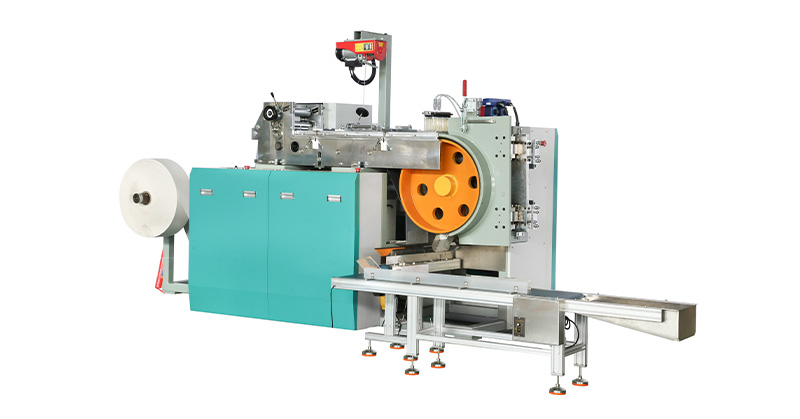
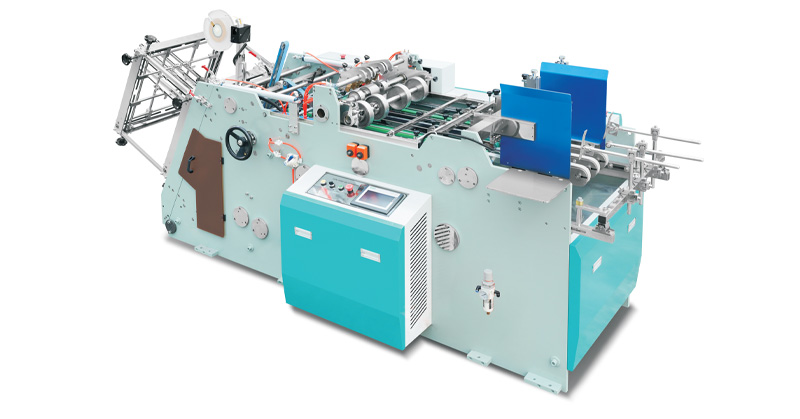
You’ve decided to invest in paper lunch box production. The market is growing—the global paper lunch box machine market is expected to grow from USD 470.8 million in 2025 to USD 1,000 million by 2035, at a CAGR of 7.8%. But with multiple machine configurations available, how do you choose the right one for your business?
The wrong choice can mean idle capacity you’re paying for, or worse, a machine that cannot keep up with orders you’ve already secured. This guide walks you through the key decision factors—production volume, box styles, automation level, adhesive system, and certification requirements—so you can make an informed choice.
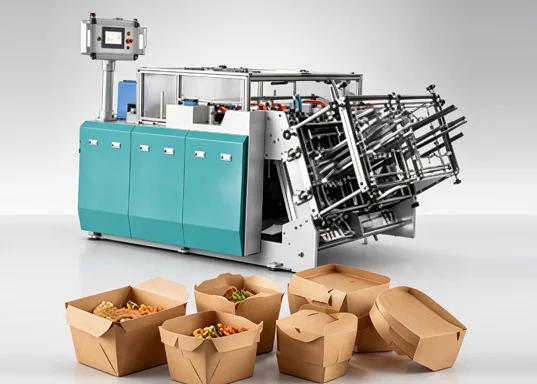
Start with Your Production Volume
The most fundamental question is: how many boxes do you need to produce?
Calculating Your Required Output
Before evaluating any machine, calculate your baseline throughput:
-
Current monthly orders — How many boxes do you need this month?
-
Projected growth — Where will volume be in 12–24 months?
-
Peak demand — What’s the highest output required during busy seasons?
-
Operating shifts — Will you run one, two, or three shifts per day?
Matching Machine Scale to Volume
Hongshuo paper lunch box machines feature a broad production capacity spanning 60 to 600 pieces per minute, with actual output determined by the selected model and customized configurations. Refer to the table below to pick the appropriate machine specification aligned with your daily or hourly production throughput.
| Monthly Volume | Recommended Configuration | Typical Speed | Best For |
|---|---|---|---|
| Under 500,000 boxes | Single station | 60–300 pcs/min | Startups, one or two box styles |
| 500,000–1,500,000 boxes | Evaluate both | — | Single at upper end may struggle; double offers growth room |
| Over 1,500,000 boxes | Double station | 120–600 pcs/min | High-volume, continuous production |
Real-World Output vs Rated Speed
A machine rated at 300 pieces per minute rarely delivers that number consistently. Factors that reduce actual output include:
-
Material quality variation — Inconsistent paper affects forming speed
-
Changeover time — Switching box styles takes time
-
Operator experience — Novice operators work more slowly
-
Maintenance stops — Regular cleaning and adjustments
Practical tip: Apply a 20–30% efficiency buffer when calculating capacity. If you need 100,000 boxes per week, look for a machine rated at 130,000–140,000 boxes per week to account for real-world factors.
Consider Your Box Style Mix
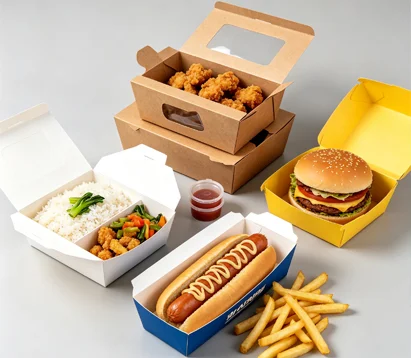
Different box styles require different machine capabilities. Hongshuo’s paper lunch box machines can produce flip-top, boat-shaped, window, fold-over, and lock-bottom structures, each requiring the correct mold design, paper material, and glue layout. The machines are designed to handle burger boxes, takeaway lunch boxes, window boxes, fold-over boxes, and lock-bottom paper boxes.
Box Style Requirements
| Box Style | Key Requirement | Glue Needed? |
|---|---|---|
| Flip-top | Precise creasing and folding | Yes |
| Boat-shaped | Curved wall forming | Yes |
| Window box | Cutting/die-cutting integration | Yes |
| Fold-over | High-pressure folding | Yes |
| Lock-bottom | Precision mechanical forming | No |
Changeover Frequency
If you produce:
-
One or two box styles — Single-station machine may suffice
-
Multiple styles with frequent changes — Double-station or servo-driven models offer faster changeovers
Double-station machines allow two different specifications to run simultaneously—meaning you can produce burger boxes on one station and cake boxes on the other without downtime for mold changes.
Evaluate Automation Level
Automation directly impacts labor requirements, consistency, and long-term operating costs.
Single-Station vs Double-Station
Hongshuo offers single-station, double-station, and independent dual-station forming solutions.
| Feature | Single Station | Double Station |
|---|---|---|
| Output | 60–300 pcs/min | 120–600 pcs/min |
| Box styles | One at a time | Two simultaneously |
| Ideal for | Startups, flexible lines | Capacity expansion |
Mechanical vs Servo Drive
Hongshuo offers three control system options: cam double-guide-rail drive, gear mechanical or servo motor option, and full servo precision forming system.
| Drive Type | Characteristics | Best Suited For |
|---|---|---|
| Cam double-guide-rail | Fixed motion; lower cost | High-volume, single-style production |
| Gear mechanical / servo option | Programmable; increased precision | Frequent changeovers, complex geometries |
| Full servo precision | ±0.1mm precision; independent control | Maximum flexibility; different styles on each station |
What this means for you: Servo-driven machines reduce operator dependency, increase precision, and maintain consistent quality across longer production runs. If you plan to produce multiple box styles or require tight tolerances, servo is worth the investment.
Choose Your Adhesive System
Adhesive choice affects both food-contact compliance and ongoing consumable costs.
Cold Glue vs Hot Melt
Hongshuo’s machines offer food-grade cold glue as standard, with hot melt adhesive available as an optional process.
| Factor | Cold Glue | Hot Melt |
|---|---|---|
| Bonding speed | Slower; requires drying | Instant |
| Food safety | FDA-compliant; low VOCs | FDA-compliant formulations available |
| Energy consumption | Lower adhesive and heating energy | Higher heating energy |
| Substrate | Best on porous paper | Works on coated and non-porous |
What this means for you: If you supply to fast-food chains or export to regulated markets, FDA-compliant cold glue systems are typically required. Hongshuo’s cold glue process is FDA-compliant as standard, with hot melt available as an option for waterproof enhancement.
Verify Certifications and Market Access
Hongshuo’s equipment carries multiple international certifications including CE, SGS, and other food-grade certifications. The company serves customers in 50+ countries.
| Target Market | Typical Certification Requirements |
|---|---|
| EU | CE |
| US | FDA food-contact compliance |
| Global export | SGS |
What this means for you: If your customers include fast-food chains or export markets, verify that your chosen machine has the necessary certifications before purchasing.
Assess Total Cost of Ownership
Purchase price is only part of the equation. Consider these long-term costs:
| Cost Factor | What to Evaluate |
|---|---|
| Consumables | Adhesive consumption, paper waste rate |
| Maintenance | Spare parts availability, service intervals |
| Energy | Power consumption per operating hour |
| Labor | Operators needed per shift |
| Downtime | Changeover time, reliability track record |
Semi-automatic lines typically cost less than fully automatic systems upfront, but the total cost of ownership over 3–5 years tells a different story. Industry best practices suggest investing in automation when manual labor costs become a significant portion of operating expenses.
Real-World Application Scenarios
Scenario A: Startup Restaurant Supplier
Profile: New packaging converter targeting local restaurants. Monthly target: 200,000–300,000 burger boxes. One box style. Single shift. Limited capital.
Recommendation: Single-station machine. The HS-800 offers flexible automatic forming for burger boxes, cake boxes, French fries boxes, packing boxes, and similar three-dimensional paper cartons at 60–300 pieces per minute.
Growth path: As volume increases, add a second single-station machine or upgrade to a double-station model.
Scenario B: Established Food Packaging Converter
Profile: Existing manufacturer expanding into paper lunch boxes. Monthly target: 1 million+ boxes. Multiple styles (burger boxes and cake boxes). Two-shift operation.
Recommendation: Double-station configuration. The HS-1200 allows two different specifications to run in a coordinated production plan at 120–600 pieces per minute. For maximum flexibility, the HS-1400 full servo independent double-station model offers precision forming with independent control.
To see how different machine configurations serve various production needs, explore the paper lunch box machine application examples for different box styles and production volumes.
Common Selection Mistakes
Mistake 1: Buying for Peak Speed, Not Sustained Output
A machine rated at 300 PPM rarely delivers 300 PPM across an entire shift. Material variations, operator breaks, and minor adjustments all reduce actual output.
Prevention: Ask suppliers for sustained output data with your specific paper grade. Run test batches if possible.
Mistake 2: Ignoring Changeover Time
If you produce multiple box styles, changeover time directly impacts available production hours.
Prevention: Factor changeover time into your capacity calculation. Servo-driven machines typically offer faster changeovers through programmable parameters.
Mistake 3: Overlooking Material Compatibility
Your chosen machine must handle your target paper grades. Hongshuo’s machines support 200–600 g/m² paperboard, cardboard, coated paper, and corrugated paper.
Prevention: Confirm material compatibility before purchase. Run your actual paper grade through the machine during testing.
From Selection to Specification
You now have a framework for choosing a paper lunch box making machine:
-
Define your production volume — Know your current and 12-month targets
-
Match station count to volume — Single station for under 500,000 boxes/month; double station for over 1.5 million
-
Consider your box style mix — More styles = more flexibility needed
-
Choose automation level — Servo for precision and changeover speed
-
Verify certifications — Match to your target markets
-
Calculate total cost — Not just purchase price
Once you’ve clarified these key decision factors, comparing the specific specifications of available options becomes the next logical step. You can review single-station configurations like the HS-800 and HS-1000 for flexible production, or double-station models like the HS-1200 and HS-1400 for high-volume scenarios.
If you would like to check the on-site running performance of different machine layouts and learn about all optional configurations alongside their rated production capacities, please browse our dedicated page for paper lunch box machine specifications and capacity options.
Related Reading
Continue building your paper lunch box production expertise with these complementary guides:
-
Paper Lunch Box Machine for Small Business vs Enterprise: Scale Selection Guide
-
Single-Station vs Double-Station Paper Lunch Box Machines: Which Configuration Fits Your Production Mix?
-
Total Cost of Ownership Comparison: Entry-Level vs Industrial Paper Stick Equipment
-
Capacity Planning for Paper Lunch Box Production: From Single Shift to 24/7 Operation